

AI in energy is already at work in the power system that keeps the lights on. It predicts how much power wind farms and solar panels will produce, watches for faults on the grid, and helps homes use electricity when it is cheapest.
The job is a hard one: electricity has to be made at the same moment it is used, and wind and sun do not follow a timetable. A grid operator has to match supply and demand every second, across millions of homes and businesses. AI is good at that kind of job: it reads huge amounts of data, spots patterns, and makes a forecast.
The numbers show how fast this is moving. The International Energy Agency (IEA) reported in April 2026 that electricity demand from data centres, the buildings that run AI, grew 17% in 2025, and demand from AI-focused data centres rose 50% in the same year. This guide covers both sides: what AI does for energy, and what AI costs in energy.
Where AI in energy shows up first
The first place AI in energy shows up is in forecasting. Wind and sun are free, but they are not steady. A wind farm can produce a lot of power at 3 a.m. and almost none at 7 a.m., and a cloudy afternoon can cut a solar farm's output in minutes. Operators need to know what is coming, so they can start other plants or shift demand.
Machine learning is well suited to this. Trained on years of weather forecasts, turbine records and grid data, it learns how a wind farm behaves in different conditions. In 2019, Google and DeepMind applied this to 700 megawatts of wind power in the central United States. Their system predicted wind output 36 hours ahead, so the grid could be promised a set amount of power a full day in advance.
The result was practical. Power that can be promised at a set time is worth more to a grid, because the operator can plan around it. DeepMind reported that the forecasts raised the value of its wind energy by roughly 20%, compared with a baseline where no time-based promises were made. The IEA's 2025 report adds that AI already improves forecasting and integration of variable renewable energy, cutting the amount of clean power switched off because the grid cannot take it.
Keeping the grid balanced as demand shifts
A power grid is a balancing act: at every second, the electricity being made has to match the electricity being used. If supply runs ahead, equipment can be damaged; if demand runs ahead, the lights go out. As more wind and solar join the grid, that balance gets harder to hold, because supply now changes with the weather as well as with demand.
AI helps by reading the whole picture at once: weather forecasts, past demand, the state of each power plant, the charge in batteries, and the flow on every major line. It can suggest which plants to run, when to charge batteries, and when to ask large users to ease off. The IEA's 2025 report puts a number on one part of this: remote sensors and AI-based management can increase the capacity of transmission lines, and applying these tools could free up as much as 175 gigawatts of capacity without building a single new line — more than the extra power data centres are expected to need by 2030.
Homes and businesses are part of the balance too. In Britain, the National Energy System Operator (NESO) runs the Demand Flexibility Service, which rewards households and businesses for changing when they use electricity. It began in winter 2022, millions have taken part, and on 27 November 2024 it went year-round. From April 2026, participants can also be rewarded for using more electricity when that helps balance the system. Taking part is always voluntary.
Finding faults before the lights go out
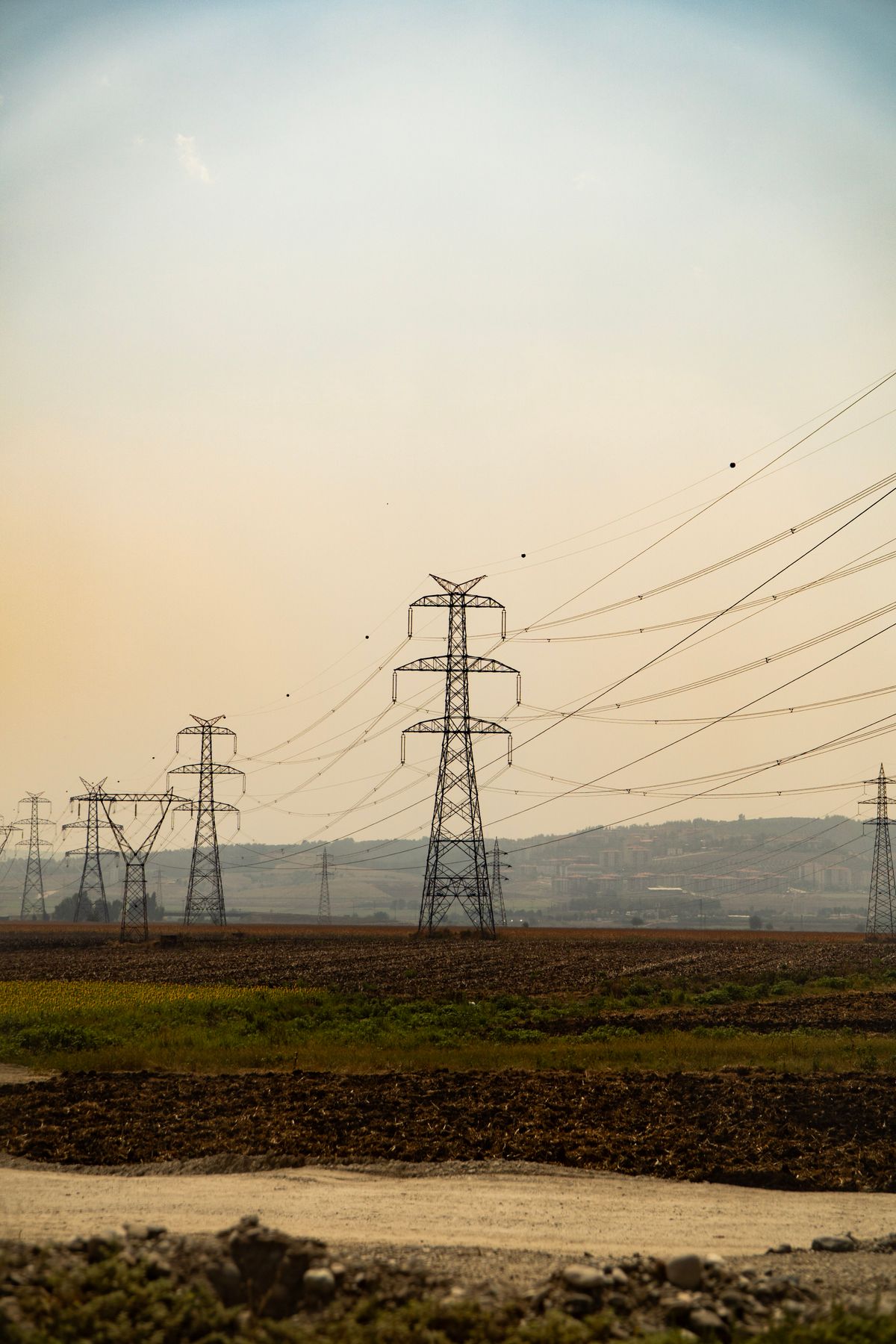
Power cuts usually start small: a transformer overheats, a cable wears thin, a connection loosens. Left alone, a small fault becomes a big one. The old way to deal with this was to inspect equipment on a fixed schedule, or to fix it after it failed.
AI changes the order of events. Sensors on transformers, lines and substations send a steady stream of readings — temperature, vibration, load, sound — and machine learning models learn what normal looks like for each piece of equipment. When a reading drifts from normal, the system flags it, and a crew can be sent before it breaks.
The IEA's 2025 report says AI-based fault detection can find and pinpoint grid faults fast, cutting outage times by 30–50%. That matters most for small businesses, where a few hours without power can mean lost sales, spoiled stock and missed deadlines. A shorter outage is not just a convenience; it is money kept.
The same approach is used inside data centres. In 2016, Google's DeepMind team trained neural networks on data from thousands of sensors inside its data centres to predict how hot each building would get in the next hour. Tested on a live data centre, the system cut the energy used for cooling by up to 40%, which meant a 15% reduction in overall power usage effectiveness overhead.
Homes, batteries and smarter bills
For most people, AI in energy will first show up at home, in devices that manage heating, cooling and charging. A smart thermostat learns when a house is occupied, and adjusts heating so it is not warming an empty room. A home battery charges when electricity is cheap and plentiful, and discharges when prices rise. An electric car can be set to charge overnight, when demand is low.
The savings add up across a whole country. The IEA's 2025 report says that if existing AI-led improvements in buildings were scaled up, they could save around 300 terawatt-hours of electricity a year — about as much as Australia and New Zealand generate. In industry, AI optimisation could save energy equivalent to more than the total energy consumption of Mexico today. The IEA's 2026 report says AI-enabled optimisation could cut energy costs by 3–10 percentage points in energy-intensive industries.
Small businesses can use the same ideas without buying new equipment. Shifting flexible work — running a dishwasher, charging a delivery van, heating water — to off-peak hours can cut a bill, and in some countries it can also earn a payment through a flexibility service like Britain's. The first step is knowing when you use power: a smart meter shows where the peaks are. Many suppliers now offer time-of-use tariffs, where electricity costs less at quiet times.
The other side: AI's own appetite for power
How much power does AI itself use? The answer, from the IEA's 2026 report, is a lot, and it is growing fast. Data centres used 485 terawatt-hours of electricity in 2025, and the IEA expects about 950 TWh by 2030, around 3% of all the electricity in the world. Demand from AI-focused data centres is expected to triple over the same period.
The United States shows the same pattern. The US Department of Energy reported in December 2024 that data centres used about 4.4% of all US electricity in 2023, up from 58 TWh in 2014 to 176 TWh in 2023, and could reach between 6.7% and 12% by 2028, or 325 to 580 TWh. Load growth has tripled over the past decade, and the department expects it to double or triple again by 2028.
The picture is not all growth. The IEA's 2026 report notes that the energy used per AI task has been falling by at least a factor of ten each year. A simple text query now typically uses less electricity than running a television over the same period. The catch is that the newest uses of AI — video generation, advanced reasoning and autonomous agents — can use hundreds or thousands of times more energy per query than a simple text answer. The hardware is getting denser too: the IEA says a single server rack in an advanced data centre could have peak power demand equal to that of 65 households by 2027. The honest version has two halves: AI can make the energy system more efficient, and it can also become one of its biggest loads.
Frequently asked questions
Does AI use more energy than it saves?
It depends on the use. The IEA's 2026 report says well-documented AI use cases could save over 13 exajoules of energy by 2035, about 3% of global final energy consumption, if barriers to wider uptake are overcome. At the same time, data centres are expected to use about 950 TWh by 2030. The savings and the cost have to be compared case by case.
Can AI stop power cuts?
No, it cannot stop them entirely, but it can make them shorter and rarer. The IEA says AI-based fault detection can cut outage times by 30–50%, because faults are found and located faster. A grid still needs well-maintained wires, transformers and backup capacity.
How can a small business cut its energy bill with AI?
Start with timing. A smart thermostat or a timer can shift heating, cooling and charging to off-peak hours, and a smart meter shows where your power goes. In Britain, the Demand Flexibility Service pays businesses to shift use at busy times. Check whether your supplier offers a time-of-use tariff or a flexibility scheme before you sign up.
AI in energy is not a single product. It is a set of tools — forecasting, fault detection, balancing, and smarter use at home — that turn data about power into better decisions about power. The gains are real and measured, from a 40% cut in cooling energy to a 20% rise in the value of wind power, and the costs are real too.
If you run a small business, the practical next step is to look at your own power use. Find your peaks, see what can move to a quieter hour, and ask your supplier what tariffs or flexibility schemes are available. If you want help using data and AI to run your business better, see our AI automation services, or get in touch through our contact page.
What to watch next
Watch for the IEA's next data centre demand update, and for whether AI-focused data centres keep growing at the 50% rate seen in 2025. Watch for more countries to copy Britain's Demand Flexibility Service, and for data centres to add batteries on site, which the IEA expects to reach 20–25 gigawatts by 2030. And watch for the skills gap: the IEA says the lack of digital skills is the single largest barrier to AI adoption in the energy sector.
Sources
- International Energy Agency — Key Questions on Energy and AI: Executive summary — date checked: 2026-11-06 — https://www.iea.org/reports/key-questions-on-energy-and-ai/executive-summary
- International Energy Agency — Energy and AI: Executive summary — date checked: 2026-11-06 — https://www.iea.org/reports/energy-and-ai/executive-summary
- Google DeepMind — DeepMind AI Reduces Google Data Centre Cooling Bill by 40% — date checked: 2026-11-06 — https://deepmind.google/blog/deepmind-ai-reduces-google-data-centre-cooling-bill-by-40/
- Google DeepMind — Machine learning can boost the value of wind energy — date checked: 2026-11-06 — https://deepmind.google/blog/machine-learning-can-boost-the-value-of-wind-energy/
- National Energy System Operator — Demand Flexibility Service explained — date checked: 2026-11-06 — https://www.neso.energy/industry-information/balancing-services/demand-flexibility-service/demand-flexibility-service-explained
- U.S. Department of Energy — DOE Releases New Report Evaluating Increase in Electricity Demand from Data Centers — date checked: 2026-11-06 — https://www.energy.gov/articles/doe-releases-new-report-evaluating-increase-electricity-demand-data-centers

Eri-Tech Global Ltd
Eri-Tech Global Ltd is a digital solutions company working with small businesses and growing brands. Learn more at /about.