Small Business Cash Flow: A Plain Guide to Money In and Out
By Eri-Tech Global Ltd · Published November 3, 2026 · Last updated November 3, 2026 · 9 min read
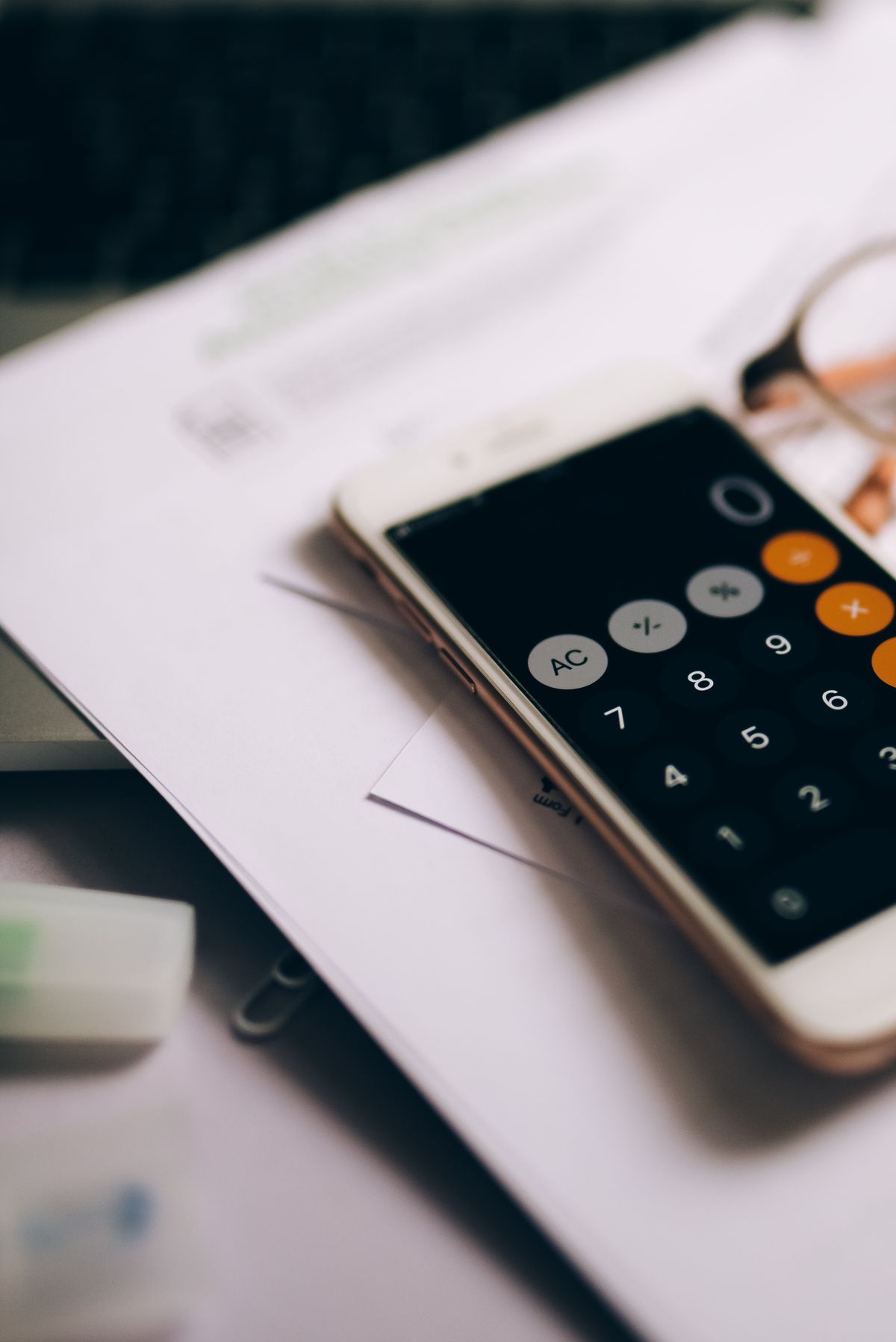
A smartphone calculator app on top of financial documents.
Small business cash flow is the movement of money into and out of a business, and the timing of that movement. Sales, customer payments, wages, rent, supplier bills, loan payments and tax bills all land on different dates, and the gaps between those dates decide whether a business can pay its bills on time.
That timing is why a business can look healthy on paper and still struggle in a given week. The United States Small Business Administration puts the point plainly: even profitable businesses can fail if they do not have the right amount of cash available at the right time.
This article explains cash flow in plain terms: what it is, how it differs from profit, the three parts of a cash flow statement, how to build a simple forecast, and what to do first when a customer pays late. It is general information, not advice about any one business.
What small business cash flow actually means
Cash flow is a record of cash in and cash out over a set period. Cash in includes money customers pay, and cash out includes money paid to suppliers, staff, landlords and lenders. When cash in is larger than cash out for a period, the business has positive cash flow for that period. When cash out is larger, it has negative cash flow for that period.
The Small Business Administration describes a cash flow statement as a document showing the timing of all cash going in and out of the business over a particular period. Two businesses can have the same sales in a month and very different cash positions at the end of it, if one is paid at once and the other waits sixty days for its invoices to be settled.
Cash flow also sits beside two other core documents. Chase for Business explains that an income statement shows profitability, but not cash balances, while a balance sheet summarises assets, liabilities and equity at a single point in time, but does not track cash flow. The cash flow statement fills the gap: it tracks cash actually moving.
Why profit on paper is not cash in the bank
Profit is calculated when revenue is earned and expenses are incurred, even if no cash has changed hands yet. Cash flow is calculated when cash changes hands. That single difference explains most cash flow surprises, and it is worth working through with an example.
Imagine a design studio invoices a client for work completed in November, with payment due in January. The income statement for November records the sale. The bank account in November does not change, because the client has not paid yet. In the same month, the studio still pays November wages, rent and software costs in cash. The business can therefore report a profit for November and still end November short of cash.
Chase for Business gives the same warning in plainer form: a business with a backlog of unpaid invoices might be profitable on paper but not have enough cash on hand to pay its bills. Regular checks catch that pattern early, before a missed payment damages a supplier relationship or leads to late fees. Profit answers the question, did the business earn more than it spent in that period, on paper. Cash flow answers a different question, did cash arrive in time to meet the bills that fell due.
The three parts of a cash flow statement
Every cash flow statement is divided into three sections: operating, investing and financing, as described by Chase for Business, Capital One and NetSuite.
Operating activities cover the day-to-day running of the business: cash in from customers, and cash out to suppliers, staff, rent, utilities and tax. NetSuite describes operating cash flow as generally the best measure of whether a company is generating cash from its core business.
Investing activities cover longer-term assets. Buying equipment, a vehicle or a second location is an investing cash outflow, and selling an asset is an investing cash inflow. A business that buys a large piece of equipment will often show negative investing cash flow in that period, and that is not, on its own, a warning sign.
Financing activities cover how the business is funded: a loan received or money put in by an owner is a cash inflow, while loan repayments, interest payments and dividends paid out are cash outflows. A loan can make total cash flow look positive in the month it arrives, which is why Chase for Business warns owners to look below the surface: a positive total driven by borrowing is not the same as one driven by customers paying.
A short worked example from Chase for Business shows how the three parts add up. In its fictional bakery example for one quarter, operating activities produced 8,000 dollars, investing activities used 13,000 dollars for a new oven and a mixer upgrade, and financing activities added 10,000 dollars from a loan after a loan payment, giving a net increase of 5,000 dollars. Add the three sections for the change in cash, then add that change to the opening balance for the closing balance.
Small business essentials: a calculator, calendar, coins, and letter tiles.
How to build a simple cash flow forecast
A cash flow statement looks backward at cash that has already moved. A forecast looks forward. NetSuite defines cash flow forecasting as estimating the amount of cash coming in and leaving a business over a specific coming period, so the business can see whether its obligations can be met.
Capital One describes a cash flow projection in the same way, and notes that projections typically cover twelve months, but can also be built weekly, monthly or quarterly. NetSuite adds that short-term forecasting often covers the next thirty to sixty days, medium-term forecasting often runs to a rolling twelve months, and longer-term forecasting looks beyond a year, with accuracy falling as the horizon gets longer.
A simple forecast needs only five lines per period, and a spreadsheet is enough to start. First, write the opening balance, which equals the closing balance of the previous period. Second, list expected cash in, using the dates customers actually pay, not the dates invoices were sent. Third, list expected cash out, using the dates bills actually fall due, including wages, rent, supplier payments, loan payments and tax. Fourth, subtract cash out from cash in to get net cash flow. Fifth, add net cash flow to the opening balance to get the closing balance.
Capital One states the two formulas in plain form. Net cash flow equals cash inflows minus cash outflows. Closing balance equals opening balance plus net cash flow. Two habits make a forecast useful rather than decorative: forecast by payment behaviour, not by hope, and update the forecast often.
A professional woman calculates finances at a desk with charts and a calculator.
When a customer pays late
Late payment is the most common way a sound forecast breaks. The work is done, the invoice is sent, and the cash arrives weeks after the wages and supplier bills it was meant to cover. The first step is a check of the terms themselves: what payment date was agreed, what date was printed on the invoice, and whether the invoice was sent on the day the work was completed rather than at the end of the month.
For business-to-business work in the United Kingdom, GOV.UK states that statutory interest on a late payment is 8 percent plus the Bank of England base rate, and that a business cannot claim statutory interest if its contract sets a different rate of interest. GOV.UK also states that a business should send a new invoice if it decides to add interest to the money it is owed.
GOV.UK gives a worked example. If a business were owed 1,000 pounds and the Bank of England base rate were 0.5 percent, the annual statutory interest would be 85 pounds, which is 1,000 pounds multiplied by 8.5 percent. Dividing 85 pounds by 365 gives daily interest of 23 pence, and after fifty days that would be 11 pounds 50 pence. Those figures use the example rate in the guidance, not a current rate, so any real claim must use the base rate that applies to the period in question.
The same guidance framework also sets fixed sums for debt recovery costs, depending on the size of the debt, and confirms business-to-business payment periods are normally expected to be within sixty days, with public authorities normally expected to pay within thirty days. Beyond any legal step, invoice on completion, state the payment date clearly, chase on the day after the due date, and keep a short list of which customers pay on time and which regularly pay much later.
Frequently asked questions
Is cash flow the same as profit?
No. Profit is revenue minus expenses for a period, recorded when sales are earned and costs are incurred. Cash flow is money actually received and paid in that period. A business can be profitable on paper and short of cash, if customers have not paid yet.
How often should a small business check its cash flow?
Weekly is a practical rhythm, with a monthly forecast alongside it. A weekly check catches a shortfall while there is still time to chase an invoice or talk to a supplier, and a monthly forecast shows the pattern across a quarter, including tax dates and seasonal stock buying.
Does negative cash flow always mean a business is in trouble?
Not always, and the reason matters more than the sign. Negative cash flow from buying equipment, or in the early months of a new business, can be planned and temporary, as Chase for Business notes for early-stage businesses. Negative operating cash flow that continues month after month is a different pattern, and it needs a closer look at pricing, payment terms, and spending.
Start with one page, for one month, filled with real dates: the cash you hold now, the payments you genuinely expect and when, and the bills that fall due and when. Compare its closing balance with your bank balance at month end, and adjust the next month for every date that was wrong.
If you would like help turning that habit into a clear website, a content system, or a simple automation for invoices and follow-ups, see the services page or get in touch through the contact page.
What to watch next
Watch payment behaviour over the next two quarters, customer by customer, rather than as a single average, which can hide the one large customer whose late payment causes most of the strain. Also watch the dates that repeat: tax payments, rent reviews, and seasonal stock buying.
AI bookkeeping can sort transactions, read receipts and draft invoices, but it still needs a human check. Learn what it does well and where it falls short.
No. QuickBooks states that its Accounting Agent does not replace a bookkeeper or accountant, and that every suggestion must be approved before posting. The tool handles data entry and matching; your accountant handles judgement, tax rules, and advice. The ACCA survey agrees: most accountants say AI improves their work, while naming verification and human judgement as the main challenges.
Will AI bookkeeping work for a cash-heavy business?
It helps only with the records it is given. Card payments and bank transfers flow in through the bank feed, but cash sales and purchases must still be recorded by hand or photographed as receipts. A cash-heavy business should treat receipt capture as the first habit, and reconcile cash against bank deposits every month.
What should I check before trusting an AI suggestion?
Three things: the category, the amount, and the document behind it. If the category looks wrong, correct it. If the amount does not match the receipt or invoice, do not approve it. If no document sits behind the entry, find one before month end. A suggestion with no document is a guess, and guesses do not belong in a ledger.
"],["What to watch next","Update this article when Intuit or Xero move their 2026 features out of beta, change plan availability, or publish independent results for time saved. Then update the figures, the date checked, and the Sources section together, and remove or correct any claim that no longer holds."]],author:"Eri-Tech Global Ltd",metaTitle:"AI Bookkeeping for Small Firms: What It Can Do",takeaways:["AI bookkeeping handles repetitive jobs: sorting transactions, matching payments, reading receipts, and drafting invoices.","QuickBooks and Xero both added AI features in 2026 that work inside the books, with a person still approving each result.","The limits are real: AI can miscategorise a transaction, beta features vary by plan and country, and odd cases still need a human.","The safest start is small: automate one task, review its suggestions weekly, and keep your accountant in the loop."]},{title:"AI Weather Forecasting: What Is Improving",slug:"ai-weather-forecasting",category:"Technology",date:"2026-11-01",updated:"2026-11-01",primaryKeyword:"AI weather forecasting",metaDescription:"AI weather forecasting now runs beside physics-based models at ECMWF and NOAA. Learn what improved, where it falls short, and how to read a forecast well.",alt:"Dark storm clouds filling the sky, suggesting an impending storm.",image:"17845906",excerpt:"AI weather forecasting now runs beside physics-based models at ECMWF and NOAA. Learn what improved, where it falls short, and how to read a forecast well.",sections:[["What AI weather forecasting means","AI weather forecasting means using software that learns from past weather data to predict what the atmosphere will do next. It does not replace the physics-based models that forecasters have used for decades. Instead, the large weather centres now run AI models beside those physics models, compare the results, and use both when they prepare the forecast you see on your phone.","A physics-based model starts with the current state of the air, then works forward using equations for air movement, heat transfer, and rain formation. An AI model is trained on large sets of past weather records, learns how one weather state changes into the next, and applies those patterns to the latest observations. That difference explains both the speed gains and the limits below.","ECMWF, the European Centre for Medium-Range Weather Forecasts, says its AI Forecasting System, called AIFS, uses the same starting conditions as its physics-based system. Those starting conditions combine a short-term forecast with around 60 million observations from satellites, planes, boats, sea buoys, and ground stations, updated every six hours.","From that starting point, the two systems part company. The physics system, with a grid spacing of 9 km, integrates the laws of physics in its code. The AI system, with a grid spacing of 28 km in its first version, uses a model trained on past weather. A smaller grid number means smaller squares, so the model can show smaller features.","NOAA, the United States National Oceanic and Atmospheric Administration, followed a similar path. Its first AI suite grew out of Project EAGLE, a joint effort between the National Weather Service, NOAA research laboratories, the Environmental Modeling Center, and the Earth Prediction Innovation Center. The team used Google DeepMind's GraphCast model as a starting point and fine-tuned it with NOAA's Global Data Assimilation System analyses, the agency's best estimates of the current atmosphere.","That history matters. An AI model is only as good as the records it learned from, and those records come from observations and earlier physics-based work. When a rare event has few past examples, the model has less to learn from."],["What has improved so far","The first clear gain is speed. ECMWF says AIFS brings increased speed and uses approximately 1,000 times less energy for making a forecast. NOAA reports a similar pattern in its own suite. Its main AI model, the Artificial Intelligence Global Forecast System, or AIGFS, produces a single 16-day forecast using only 0.3% of the computing resources of the traditional Global Forecast System, and finishes in approximately 40 minutes.","Speed matters because a forecast is only useful if it arrives in time to act on. A faster run leaves more time to check the result, to run a second version, and to prepare a warning. It also lowers the computing bill, which is why centres can run more versions of the same forecast.","The second gain is in storm tracks. ECMWF reported on 25 February 2025, when AIFS became operational, that it outperforms state-of-the-art physics-based models for many measures, including tropical cyclone tracks, with gains of up to 20%. A tropical cyclone track is the path a storm is expected to follow. A better track helps a coastal town know sooner whether it sits in the likely path, and helps a shipping firm or an airline plan a safer route.","NOAA reported the same pattern. Its AIGFS shows a significant reduction in tropical cyclone track errors at longer lead times, so the forecast of where a storm will go stays useful further ahead. Its ensemble system, AIGEFS, which runs 31 slightly different versions to show a range of outcomes, extends useful forecast skill by 18 to 24 hours compared with the traditional ensemble system, while using only 9% of its computing resources.","The third gain is in how ensembles are combined. NOAA also runs a hybrid system, HGEFS, which joins the 31 AI members with the 31 physics members into a 62-member set. In initial testing, that combined set consistently outperformed both the AI-only and physics-only sets across most major checks. Two different methods, each with its own blind spots, can give a steadier answer together than either gives alone.","ECMWF moved in the same direction. After launching the single-forecast version, AIFS Single, in February 2025, it launched an ensemble version in July 2025. An ensemble is a group of forecasts with small differences in starting conditions. When most members agree, confidence is higher. When they spread apart, that spread is itself useful information."],["Where AI forecasts still fall short","The same reports that praise storm tracks are careful about storm strength. NOAA said its first AI version, v1.0, shows a degradation in tropical cyclone intensity forecasts, even as track forecasts improve. Intensity means how strong a storm is, including its wind speed. A forecast that places a storm correctly but understates its strength can still mislead a reader who only checks the path.","A wooden barn under dark thunderclouds.","That weakness is now being worked on in public. On 27 July 2026, the National Weather Service put an upgraded version, AIGFS v1.1, into use. Its notice says the changes improve tropical cyclone intensity forecasts, improve forecast precipitation, and reduce blurring at longer lead times. Blurring means a forecast that smooths out sharp detail as it looks further ahead, so a heavy rain band looks like a wide, light patch instead. The upgrade came from changes to the training method, including fine-tuning on four years of Global Data Assimilation System analysis.","A second limit is local detail. The World Meteorological Organization, known as WMO, noted in October 2025 that considerable challenges remain in AI systems' capability to support forecasts of local high-impact weather and hydrological processes, including floods and river flows. A global model with a 28 km grid cannot, on its own, show a single valley thunderstorm or a street-level flood. Local forecasters still need local observations, radar, and ground knowledge to turn a global forecast into a useful local warning.","A third limit is the rare event. AI models learn from the past, so an event with few past examples is harder for them to handle. That is why WMO's message is firm: AI must complement, not replace, existing forecasting methods and infrastructure. The physics models, the observation network, and the human forecaster all stay in the chain.","A fourth limit is trust in the result. An AI model can produce a confident-looking map without showing its working in the way a physics equation can be inspected. Forecasters therefore check AI output against physics output and observations. A reader can do a simpler version: compare two sources, look at the timing, and treat a single model run as one view, not a verdict."],["How to read a forecast with care","Start with the warning, not the icon. A weather app icon shows one outcome for one place at one time. A warning from a national meteorological service, or from a local authority, is the decision that matters for safety. If the app and the warning disagree, follow the warning.","Next, look at the range. Many forecast pages now show a spread of possible temperatures or rainfall amounts. A narrow spread means the models mostly agree. A wide spread means the outcome is still open, and a plan that depends on a single number is risky. For a delivery or an outdoor event, a wide spread is a signal to prepare a second option, not a reason to cancel at once.","A calm sky over the ocean at sunset.","Then check the place and the time in detail. A forecast for a city can hide big differences between a hillside and a valley, or between a coast and an inland town. Read the hourly view, not only the daily summary, when the decision involves travel, stock, or staff safety.","For a small business, turn the forecast into a short list before the season starts. Decide in advance what you will do if heavy rain is forecast for a delivery day, strong wind for an outdoor stall, or extreme heat for staff working outside. Write down who decides and how customers will be told. A better forecast helps most when the response is already agreed.","Finally, keep a simple record. Note the forecast you acted on, the warning you followed, and what actually happened. Over a season, that record shows which source you trust for your area."],["What to do next","If you run a small business, pick one weather-sensitive task this week and write its rain plan in three lines: the trigger, the action, and the person in charge. A trigger could be a heavy rain warning for your town. An action could be moving stock off the floor, confirming a delivery by phone, or shifting an outdoor job to the morning.","If you only want a better daily habit, choose one trusted source for warnings in your country and one forecast app for planning, in that order. Check the warning first, then the app for timing. When the two disagree, wait for the next update rather than picking the version you prefer.","If you work in farming, transport, energy, or construction, ask your forecast provider which models sit behind its product, and whether it shows an ensemble spread."],["Frequently asked questions","
Does AI weather forecasting replace human forecasters?
No. ECMWF and NOAA both run AI models beside physics-based models, and WMO says AI must complement, not replace, existing methods. Human forecasters check the models, add local knowledge, and issue warnings.
Why can two forecast apps disagree on the same day?
Because they may use different models, different starting data, or different ways of turning a global forecast into a local one. A disagreement is a sign of uncertainty, not proof that one app is broken. Check the warning source and the ensemble spread before you decide.
Is a faster forecast always a more accurate forecast?
No. Speed helps a forecast arrive in time and allows more versions to be run, but accuracy still depends on the observations, the training data, and the limits described above, including storm strength and local detail.
"],["Closing","AI weather forecasting has improved the speed, cost, and storm-track skill of global forecasts, and that improvement is now part of daily operations at major centres. It has not removed uncertainty, and it has not replaced the need for local warnings, careful reading, and a plan made in advance.","If you would like help turning clear, checked explanations like this into content, a website, or a workflow for your own business, explore our services or get in touch through our contact page for a free consultation."],["What to watch next","This article should be updated when NOAA issues a further AIGFS upgrade, when ECMWF reports a new AIFS version, or when WMO publishes progress on Early Warnings for All. At that point, the new figures, the date checked, and the Sources section should all be updated together, and any claim that no longer holds should be removed or corrected."]],author:"Eri-Tech Global Ltd",metaTitle:"AI Weather Forecasting: What Is Improving",takeaways:["AI weather forecasting now runs in daily operations at ECMWF and NOAA, beside physics-based models, not in place of them.","The gains so far are clearest in speed, computing cost, and the track of large storms, while storm strength remains harder to get right.","A forecast is a range of possible outcomes, not a single fixed result, so checking the timing, the place, and the warning source matters more than any single number.","For a small business, the best use of a better forecast is a simple plan made in advance: what you will move, cover, delay, or confirm when a warning appears."]},{title:"AI in Public Services: What Governments Do With It",slug:"ai-public-services-governments",category:"Politics & Policy",date:"2026-10-31",updated:"2026-10-31",primaryKeyword:"AI in public services",metaDescription:"Learn how AI is used in public services, where it helps most, what the risks are, and which checks keep a person in charge of decisions that matter today.",alt:"The National Assembly building in Belgrade with a green dome and classical columns in warm daylight.",image:"28451083",excerpt:"Learn how AI is used in public services, where it helps most, what the risks are, and which checks keep a person in charge of decisions that matter today.",sections:[["What AI in public services usually means","AI in public services means software used by a government body, or on its behalf, to help run a service that people use. That can be as small as a search tool that helps a visitor find the right form, or as large as a system that sorts a long queue of requests so staff can deal with the most time-sensitive cases first. The word AI covers several kinds of software. Some systems follow fixed rules written in advance. Others learn patterns from past data, and then use those patterns to sort, summarise, or predict. A newer kind, generative AI, can draft text or answer a question in plain words. Knowing which kind is in use matters, because each kind fails in a different way, and each kind needs a different check.","This article explains where AI in public services is most often used, what it is meant to improve, where the risks sit, and what checks a careful service puts around it. It draws on the OECD, an international body that studies how governments work, and on the UK Government's service guidance. It does not rank countries or predict what any government will do next. The point is simpler: if you use a public service, you should be able to tell when AI is involved, what it does, and how to reach a person when the answer looks wrong.","Start with the job, not the tool. A public service has a queue, a set of rules, and a record to keep. A person applies, asks, reports, or pays, and staff check the details, apply the rule, and record the result. AI enters that chain in three places: helping the person at the front find the right page or guidance, helping staff in the middle sort cases and pull records together, and helping managers at the back see where delays and errors build up.","None of those uses means the machine decides on its own. In the OECD's account, most cases used older, rules-based methods or established machine learning, which means software trained to spot patterns in data. Generative AI, including large language models, was less common. That distinction matters. A rules-based tool does what its rules say, and its mistakes can usually be traced to a rule. A pattern-based tool is harder to trace, because its answer comes from many small signals in its training data. A generative tool can write a smooth, confident answer that is still wrong, because it is built to produce likely text, not to check a fact against a record."],["Where it shows up first","The OECD report Governing with Artificial Intelligence, published on 18 September 2025, looked at 200 cases across 11 core functions of government. It found AI most common, in terms of total cases, in public service delivery and justice functions and in civic participation. Use was less common in policy evaluation, tax administration, and civil service reform. In between sat public procurement, financial management, fighting corruption and promoting public integrity, and regulatory design and delivery.","That pattern makes sense when you think about the work. Public service delivery covers many everyday tasks, so there are many routine steps that can be automated. Justice administration, the OECD notes, faces public demand and growing backlogs. Tax administration faces strict rules on how tax data may be used, which limits what a tool can be given. Policy evaluation often needs judgment about a whole programme, not a single case.","The benefits found most often were also plain. The largest share of cases aimed for automated, streamlined, and tailored processes and services. The next groups aimed for better decision-making and forecasting, and for stronger accountability and anomaly detection, which means spotting cases that do not fit the usual pattern, such as a possible error or fraud. The OECD also records an Alan Turing Institute estimate that AI could automate 84% of repetitive public service transactions in the United Kingdom, saving the equivalent of 1,200 person-years of work each year. That is an estimate of what could be automated, not what has been."],["Why the same tool needs different checks","A tool that helps a visitor find a form and a tool that helps decide whether a person qualifies for a benefit are not the same risk, even if both use similar software. The OECD puts the point plainly: there is no such thing as risk-free AI adoption. Biased algorithms, meaning software whose results treat some groups unfairly because of the data or rules behind it, can lead to adverse outcomes. Misuse of AI can infringe on, or prevent the free exercise of, human rights. Too little transparency, which means too little clear information about how a decision was reached, can weaken accountability and cause public resistance. Over-reliance, meaning trusting an output without checking it, can widen digital divides, which are gaps between people who can use digital services easily and people who cannot, and can let a single error repeat across many cases.","Those risks grow at scale. One wrong answer in a chatbot is a nuisance. The same wrong pattern applied to thousands of cases becomes a systemic error, meaning an error built into the system itself. A team that cannot explain its own tool cannot check it, or fix it quickly. There is also a risk on the other side: governments that fail to use AI miss chances to improve services. So the choice is between a tool with checks, a tool without checks, and a slow service that leaves old problems in place."],["The checks that keep a person in charge","The OECD groups what governments need into three parts: enablers, guardrails, and engagement. Enablers are the foundations, such as governance, good data, digital infrastructure, skills, and funding. Guardrails are the rules and checks that run through the life of a system, such as policies, guidance, transparency and accountability mechanisms, and oversight bodies. Engagement means ways for the public, civil society, and businesses to shape a service meant for them.","The UK Government's service guidance, updated on 15 October 2026, turns the same ideas into rules for a single service. It says a service using AI must be safe for users, protect their data, be as environmentally sustainable as possible, and stay secure. AI should only be used where there is clear evidence of a user need, and more established technology may solve the problem better. If a clearer form would fix the problem, AI is not needed.","The guidance also sets out what users must be told. If AI is used, a service must make clear how that affects a user's data and the outcome they receive. If it uses an AI-powered chatbot, users must understand that the answers do not come from a human and might not be accurate, and they must know how to contact a human being. The service must be accurate, users must be protected from bias, the service owner must understand the technology and its risks, and someone on the team must be able to explain the service's use of AI. Security professionals must be involved early, and the service must be monitored through its life, with the team prepared to stop using AI if needed. A UK Government answer given in Parliament on 11 March 2026 adds the same shape for tools handling sensitive data: the Artificial Intelligence Playbook for the UK Government and the Generative AI Framework for UK Government, both published in February 2025, stress data protection impact assessments, clear accountability, and human oversight.","Put together, those checks form a short test. Is it clear that AI is involved? Can someone explain the result? Is there a human route when the result looks wrong? Is personal data handled under a clear rule, with a check done before launch? And is the tool still watched after launch, with a way to stop it? A service that answers yes to all five is not free of risk, but it has the parts that let a mistake be found and fixed.","An office worker reviewing documents at a computer, representing everyday administrative work."],["What to watch next","The OECD is clear that many government AI efforts are still at an early stage, and that scaling up a successful pilot is hard. Skills gaps and difficulty in obtaining and sharing quality data appear across government functions. Strategies are common, but a lack of concrete guidance can stop a strategy from becoming practice. Monitoring is often too weak to show progress or spot risks, and costs are a common challenge.","The OECD's advice is to start with high-benefit, low-risk applications: cases where the gain is clear, such as cutting a backlog, and the harm if the tool errs is limited and can be caught by a person. Most governments still lack processes to measure results in full, covering spending efficiency, service quality, and potential harms. For readers, the signs to watch are simpler: does the service say, in plain words, when AI is involved? Does it keep a human route open? Is it checked over time?","A quiet public library reading room with tables and bookshelves, representing access to public information."],["Frequently asked questions","
Does AI decide whether I qualify for a public service?
It depends on the service, and the service should say. AI was most often used to automate routine steps, sort cases, and help staff find information. A careful service keeps a person responsible for a decision that affects rights or money.
What should I do if an AI answer looks wrong?
Do not rely on it alone. Use the human route the service gives, keep a copy of the answer, and check the result against the official guidance or form. The UK guidance requires an AI chatbot to tell users how to contact a human being.
Why do some public services use AI while others do not?
Because the work differs. Services with many routine cases have more places where a tool helps. Services with strict data rules, such as tax administration, or with narrow judgment work, such as policy evaluation, have fewer, according to the OECD's study of 200 cases.
"],["A careful way forward","AI in public services is best judged case by case. A tool that helps a visitor find the right form, with a person on hand, is a different matter from a tool that sorts cases affecting money or rights with no human check. The OECD's study gives a fair starting point: routine work first, clear gains, measured results, and safeguards through the life of the system. The UK guidance adds the reader's side: tell users when AI is involved, protect them from bias, keep a human route open, and be ready to stop a tool that does not hold up.","If you run a small business, use that same order online. Start with the official page, not a chatbot summary. Save the result and the date you saw it. If a step affects a payment, a licence, or a right, confirm it with a person first. For help putting a similar check into your own firm's tools, explore our services, or get in touch through our contact page."]],author:"Eri-Tech Global Ltd",metaTitle:"AI in Public Services: What Governments Do With It",takeaways:["AI in public services is most often used to automate routine steps, sort requests, and help staff find information faster.","The OECD studied 200 cases across 11 core government functions, and found use most common in public services, justice functions, and civic participation.","The main risks are biased results, unclear decisions, and too much trust in an output that no one has checked.","Good practice keeps a person in charge: users are told when AI is involved, staff can explain the result, and a human route stays open."]}, {title:
Learn how AI can speed up service pricing for small firms, from listing costs to break-even checks, while keeping your real costs and customers in charge.